<?xml version="1.0" encoding="utf-8"?><feed xmlns="http://www.w3.org/2005/Atom" ><generator uri="https://jekyllrb.com/" version="3.10.0">Jekyll</generator><link href="https://inidun.github.io/feed.xml" rel="self" type="application/atom+xml" /><link href="https://inidun.github.io/" rel="alternate" type="text/html" /><updated>2025-05-14T13:44:02+02:00</updated><id>https://inidun.github.io/feed.xml</id><title type="html">International Ideas at UNESCO</title><subtitle>A Digital Approaches to Global Conceptual History</subtitle><author><name>International Ideas at UNESCO</name></author><entry><title type="html">Test</title><link href="https://inidun.github.io/posts/2022/11/02/test/" rel="alternate" type="text/html" title="Test" /><published>2022-11-02T00:00:00+01:00</published><updated>2022-11-02T00:00:00+01:00</updated><id>https://inidun.github.io/posts/2022/11/02/test</id><content type="html" xml:base="https://inidun.github.io/posts/2022/11/02/test/"><![CDATA[<figure class=""><img src="/images/unesco-stair.jpg" alt="Staircase at UNESCO HQ, Paris." /><figcaption>
      Staircase at UNESCO HQ, Paris.

    </figcaption></figure>

<p>Here’s my test blog post!</p>]]></content><author><name>Benjamin G. Martin</name></author><summary type="html"><![CDATA[Staircase at UNESCO HQ, Paris.]]></summary></entry><entry><title type="html">Global and digital intellectual history?</title><link href="https://inidun.github.io/posts/2020/12/18/INIDUN-on-UU-DH-blog/" rel="alternate" type="text/html" title="Global and digital intellectual history?" /><published>2020-12-18T00:00:00+01:00</published><updated>2020-12-18T00:00:00+01:00</updated><id>https://inidun.github.io/posts/2020/12/18/INIDUN-on-UU-blog</id><content type="html" xml:base="https://inidun.github.io/posts/2020/12/18/INIDUN-on-UU-DH-blog/"><![CDATA[<p>Can intellectual history’s digital and global turns be brought together in a way that benefits both?</p>

<p>A short piece of mine, on how the INIDUN project seeks to address this question, is now up on the <a href="https://digitalhumanities.blogg.uu.se/2020/12/17/a-digital-approach-to-global-intellectual-history-text-mining-unesco/">blog of the Uppsala University Digital Humanities network</a>.</p>

<p>Thanks to Matts Lindström for the invitation to present our project there!</p>]]></content><author><name>Benjamin G. Martin</name></author><summary type="html"><![CDATA[Can intellectual history’s digital and global turns be brought together in a way that benefits both?]]></summary></entry><entry><title type="html">Welcome! Setting up and getting started</title><link href="https://inidun.github.io/posts/2020/06/30/welcome-to-inidun/" rel="alternate" type="text/html" title="Welcome! Setting up and getting started" /><published>2020-06-30T00:00:00+02:00</published><updated>2020-06-30T00:00:00+02:00</updated><id>https://inidun.github.io/posts/2020/06/30/welcome-to-inidun</id><content type="html" xml:base="https://inidun.github.io/posts/2020/06/30/welcome-to-inidun/"><![CDATA[<p>This is the blog where we will post updates about our research project Inidun: INternational IDeas at UNesco. Our plan was to get started with a kick-off meeting in Umeå in May; that ended up, of course, being a series of zoom-calls instead. Nonetheless, we are now off and running, on several fronts.</p>

<p>First, it seemed important to make some decisions about how to run the project: how would we – me (Ben Martin), my co-researcher Fredrik Norén, and the systems developers at Humlab (chiefly Roger Mähler and Andreas Marklund) – collaborate and communicate, where would data and code be kept, and so on? Trained as a decidedly non-digital historian and with my background in the American university system, collaborating with others at all has been new, to say nothing of doing so where large data sets and bespoke digital tools are involved.</p>

<p>The short version of what we decided is that we will be working to a high degree in and through GitHub: that is where our data and code will live, <a href="https://github.com/inidun">as you can see</a>. It is where we will define our goals and chart our progress, and it is where (or rather the tool through which) we will (largely) communicate. Working in this way is new to us; tips and suggestions are most welcome!</p>]]></content><author><name>Benjamin G. Martin</name></author><category term="inidun" /><category term="update" /><summary type="html"><![CDATA[This is the blog where we will post updates about our research project Inidun: INternational IDeas at UNesco. Our plan was to get started with a kick-off meeting in Umeå in May; that ended up, of course, being a series of zoom-calls instead. Nonetheless, we are now off and running, on several fronts.]]></summary></entry><entry><title type="html">Welcome to Jekyll!</title><link href="https://inidun.github.io/posts/2020/06/15/welcome-to-jekyll/" rel="alternate" type="text/html" title="Welcome to Jekyll!" /><published>2020-06-15T11:22:37+02:00</published><updated>2020-06-15T11:22:37+02:00</updated><id>https://inidun.github.io/posts/2020/06/15/welcome-to-jekyll</id><content type="html" xml:base="https://inidun.github.io/posts/2020/06/15/welcome-to-jekyll/"><![CDATA[<p>You’ll find this post in your <code class="language-plaintext highlighter-rouge">_posts</code> directory. Go ahead and edit it and re-build the site to see your changes. You can rebuild the site in many different ways, but the most common way is to run <code class="language-plaintext highlighter-rouge">jekyll serve</code>, which launches a web server and auto-regenerates your site when a file is updated.</p>

<p>Jekyll requires blog post files to be named according to the following format:</p>

<p><code class="language-plaintext highlighter-rouge">YEAR-MONTH-DAY-title.MARKUP</code></p>

<p>Where <code class="language-plaintext highlighter-rouge">YEAR</code> is a four-digit number, <code class="language-plaintext highlighter-rouge">MONTH</code> and <code class="language-plaintext highlighter-rouge">DAY</code> are both two-digit numbers, and <code class="language-plaintext highlighter-rouge">MARKUP</code> is the file extension representing the format used in the file. After that, include the necessary front matter. Take a look at the source for this post to get an idea about how it works.</p>

<p>Jekyll also offers powerful support for code snippets:</p>

<figure class="highlight"><pre><code class="language-ruby" data-lang="ruby"><span class="k">def</span> <span class="nf">print_hi</span><span class="p">(</span><span class="nb">name</span><span class="p">)</span>
  <span class="nb">puts</span> <span class="s2">"Hi, </span><span class="si">#{</span><span class="nb">name</span><span class="si">}</span><span class="s2">"</span>
<span class="k">end</span>
<span class="n">print_hi</span><span class="p">(</span><span class="s1">'Tom'</span><span class="p">)</span>
<span class="c1">#=&gt; prints 'Hi, Tom' to STDOUT.</span></code></pre></figure>

<p>Check out the <a href="https://jekyllrb.com/docs/home">Jekyll docs</a> for more info on how to get the most out of Jekyll. File all bugs/feature requests at <a href="https://github.com/jekyll/jekyll">Jekyll’s GitHub repo</a>. If you have questions, you can ask them on <a href="https://talk.jekyllrb.com/">Jekyll Talk</a>.</p>]]></content><author><name>International Ideas at UNESCO</name></author><category term="jekyll" /><category term="update" /><summary type="html"><![CDATA[You’ll find this post in your _posts directory. Go ahead and edit it and re-build the site to see your changes. You can rebuild the site in many different ways, but the most common way is to run jekyll serve, which launches a web server and auto-regenerates your site when a file is updated.]]></summary></entry><entry><title type="html">Fredrik’s first blog post</title><link href="https://inidun.github.io/posts/2020/06/14/fredriks-first-blog-post/" rel="alternate" type="text/html" title="Fredrik’s first blog post" /><published>2020-06-14T00:00:00+02:00</published><updated>2020-06-14T00:00:00+02:00</updated><id>https://inidun.github.io/posts/2020/06/14/fredriks-first-blog-post</id><content type="html" xml:base="https://inidun.github.io/posts/2020/06/14/fredriks-first-blog-post/"><![CDATA[<p>Blog posts are cool.</p>

<h1 id="headings-are-cool">Headings are cool</h1>

<h1 id="you-can-have-many-headings">You can have many headings</h1>

<h2 id="arent-headings-cool">Aren’t headings cool?</h2>]]></content><author><name>Fredrik Norén</name></author><category term="cool posts" /><category term="category1" /><category term="category2" /><summary type="html"><![CDATA[Blog posts are cool.]]></summary></entry><entry><title type="html">Presenting the Project in Lund</title><link href="https://inidun.github.io/posts/2020/08/20/lund-blog-post/" rel="alternate" type="text/html" title="Presenting the Project in Lund" /><published>2020-06-14T00:00:00+02:00</published><updated>2020-06-14T00:00:00+02:00</updated><id>https://inidun.github.io/posts/2020/08/20/presenting-in-lund</id><content type="html" xml:base="https://inidun.github.io/posts/2020/08/20/lund-blog-post/"><![CDATA[<p>“Nordic Media Histories” was the topic of the three-day symposium at Lund University, 12-14 August 2020, to which I was invited to give one of two keynote presentations. (The other one was by USC historian Nick Cull, in whose company I was quite pleased to find myself.) But we were told that there was no need to focus on the Nordic countries; we should, rather, offer broad perspectives that could be of interest for media historians focusing on matters of propaganda and information in the post-1945 period.</p>

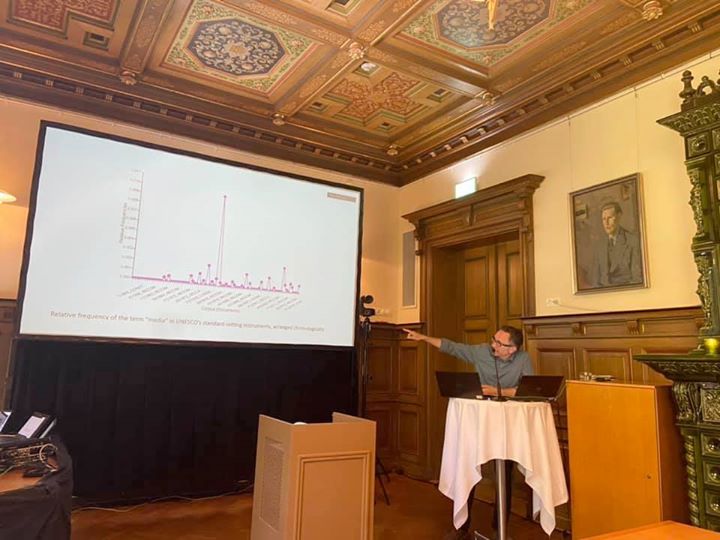
<figure class=""><img src="/images/Ben_in_Lund_20200813.jpg" alt="Ben presenting the project in Lund, 13 August 2020." /><figcaption>
      Ben presenting the project in Lund, 13 August 2020.

    </figcaption></figure>

<p>Seizing the moment to get busy with our INIDUN project, I presented a paper entitled “Transnational Media Histories of (or rather, through) UNESCO: An International and Digital Approach.” Here, after presenting the project over all (and trying, more or less successfully, I think, to show its relevance to the context of the symposium), I discussed the results of my recent exploration of one part of our UNESCO text corpus: the organization’s <a href="http://portal.unesco.org/en/ev.php-URL_ID=23772&amp;URL_DO=DO_TOPIC&amp;URL_SECTION=201.html">standard-setting instruments</a>, or SSIs. These are the conventions, resolutions, and declarations that UNESCO has adopted, some 82 in all (from the 1945 constitution that founded UNESCO to the “Recommendation on Open Educational Resources” of November 2019). Assembled as a text corpus, they amount to 286,235 words. By way of preliminary exploration, I fed this corpus into the online text analysis tool <a href="https://voyant-tools.org/">Voyant</a>, using this to identify word trends, collocates, and more.</p>

<p>One simple but striking finding was this: UNESCO would seem to have been an organization with a deep and long-standing concern with matters pertaining to the media. After all, <a href="http://portal.unesco.org/en/ev.php-URL_ID=15244&amp;URL_DO=DO_TOPIC&amp;URL_SECTION=201.html">UNESCO’s founding constitution</a> explains that, to realize its purpose, the organization will “Collaborate in the work of advancing the mutual knowledge and understanding of peoples, through all means of mass communication and to that end recommend such international agreements as may be necessary to promote the free flow of ideas by word and image.”</p>

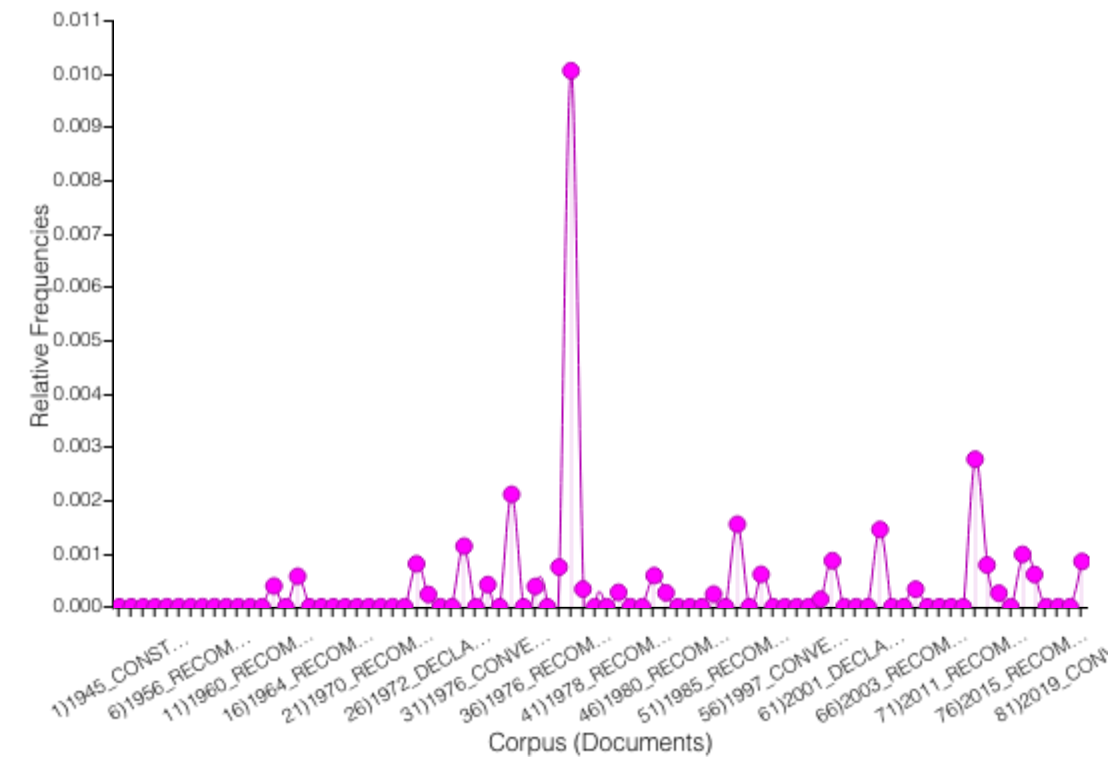
<p>So, how often have “media” in fact been an explicit focus of UNESCO’s SSIs? As you can see, not often at all.</p>

<figure class=""><img src="/images/SSI_term_frequency_media_Voyant.png" alt="Relative frequency of the word media in UNESCO SSIs, 1945-2019." /><figcaption>
      Relative frequency of the word media in UNESCO SSIs, 1945-2019.

    </figcaption></figure>

<p>With one major exception: the spike in the middle is the Mass Media Declaration (actually called the Declaration on Fundamental Principles concerning the Contribution of the Mass Media to Strengthening Peace and International Understanding, to the Promotion of Human Rights and to Countering Racialism, Apartheid and Incitement to War) adopted by UNESCO’s General Conference in November 1978.</p>

<p>Scholars are aware of this Declaration, of course, and it’s no surprise to find a spike in that word’s use at that point. But for us, this is interesting: it seemed reasonable to think that “media” was a natural field for UNESCO, yet in fact there was, apparently, only one moment in UNESCO’s history when media was a major issue — or, at least, an issue major enough to lead to the adoption of an SSI. It is striking, too, that “media” was not a significant term before <em>or after</em> that date. (The later small spike is a 2015 declaration on sports, that invites “the media,” among other social forces, to promote the value of physical education and exercise.)</p>

<p>We know that the Mass Media Declaration reflected the ideas and goals of the controversial effort to create a “New World Information and Communications Order” – an effort that led the USA and UK to withdraw from UNESCO altogether. Could it be that what we see in this graph is a story: in which an effort to pull the media to the heart of UNESCO’s concerns was followed by silence on that issue when the effort was defeated?</p>

<p>Stay tuned…!</p>]]></content><author><name>Benjamin G. Martin</name></author><summary type="html"><![CDATA[“Nordic Media Histories” was the topic of the three-day symposium at Lund University, 12-14 August 2020, to which I was invited to give one of two keynote presentations. (The other one was by USC historian Nick Cull, in whose company I was quite pleased to find myself.) But we were told that there was no need to focus on the Nordic countries; we should, rather, offer broad perspectives that could be of interest for media historians focusing on matters of propaganda and information in the post-1945 period.]]></summary></entry></feed>